

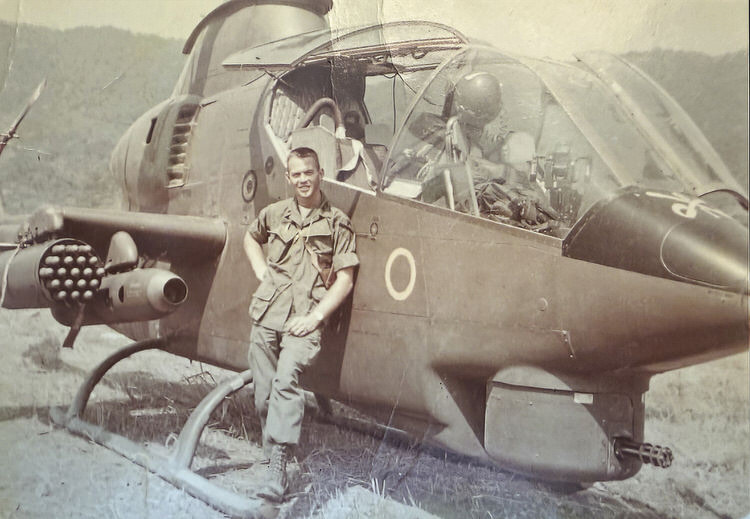
Roy and his workhorse AH-1 Cobra
Michael Pate
Retired Army Major Roy Walton
The first thing you notice when you meet fellow Ranch resident Roy Walton is his height. At 6’4”, he stands above most of us—and that feels fitting, because in terms of service and bravery, he towers even higher. For over fifty years, Roy served the country he loves as a soldier, an officer, and an Army Civilian. And early in that lengthy career, during his tour in Vietnam, he bravely faced high risk situations and a moment of terror that would alter the course of his life.
Early Years
Born in Houma, La., southwest of New Orleans, Roy was the youngest of eight children. He fondly remembers listening to his mother play church hymns at the local First Baptist Church, water skiing in the bayou, playing football (both tight end and defensive back), running the high hurdles, and, of course, shrimp. Growing up on the Louisiana coast meant shrimp was plentiful, and Roy was perfectly happy about that.
You’re in the Army Now
After two semesters at Nicholls State College in nearby Thibodaux, Roy ran low on funds and needed to find work. At 19, he enlisted in the Army, trained as a Construction Draftsman, and was assigned to an Air Defense unit in Washington State—where, ironically, there was no construction and no need for a draftsman. Instead, he was placed in the command post, screening air traffic in the northwest sector of U.S. airspace, watching for potential hostiles. That unexpected assignment sparked his interest in flying.
After three years in the Army, Roy enrolled in Officer Candidate School. Upon earning his commission, he attended Primary Helicopter School at Fort Wolters, Texas, followed by advanced flight training at Fort Rucker, Ala., where he learned to fly Bell UH 1 “Huey” helicopters. Eight months later, newly trained, and barely settled into his role as an aviator, Roy was on his way to seeing combat action.
’Nam
At just 24, Roy entered the Vietnam War. His first assignment was reconnaissance missions flying Bell OH 13 “Sioux” helicopters. Within a month, he transitioned to flying Huey gunships—aircraft armed with M 60 machine guns on flexible mounts—providing critical fire support for ground troops.
In 1967, after a brief, intense training period, Roy became one of the first pilots in Vietnam to fly the newly introduced Bell AH 1 “Cobra,” the first purpose built attack helicopter of the war. Sleek and narrow, with tandem seating, the Cobra was fast and presented a smaller target profile while carrying formidable firepower: M134 miniguns and rockets. This aircraft became Roy’s workhorse for the remainder of his tour.
Risky Business
A typical day began at first light. Roy launched into the sky for reconnaissance runs and fire support missions, often flying continuously until nightfall with only short breaks to refuel or rearm. “I don’t think there’s a day that went by that I wasn’t shot at,” he recalled. Asked how he handled the constant threat of enemy fire, Roy shrugged it off with characteristic humility: “We tried not to think about that. Besides, flying those Cobras was fun!”
The pace was grueling. Over eight months of near constant flying, he lost 40 pounds. “My day started before breakfast, and by the time I got back, dinner was over,” he recalled. “I consumed a lot of C-rations.”
Night missions were even more harrowing. Protocol required a total blackout—all exterior position lights switched off. “We were literally flying blind,” Roy said. “With other helicopters in tight formation, it was really scary. You could never see them to tell where they were.”