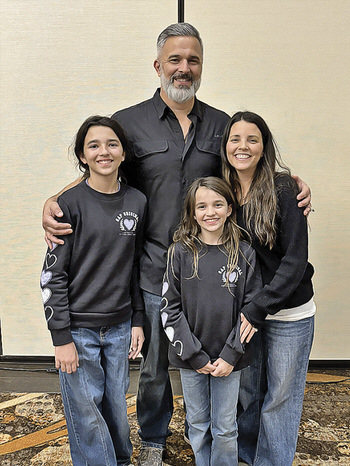
Ryan Kagay and family
Cris Thompson
The Catholic Community began the new year with a roomful of members eager to learn about the Early Church Fathers at the January meeting. Speaker Ryan Kagay is a father of six children and an entrepreneur who owns several businesses. He served as a U.S. Marines and is a combat veteran of Operation Iraqi Freedom. Ryan is active in several St. Mark Catholic Church ministries, including leading the Saturday morning Men’s Rosary and Fellowship group. He is currently in the discernment phase for the Diocese of Fort Worth diaconate program.
Ryan emphasized that understanding the history of the Church magnifies the beauty of the Catholic faith and enables us to speak about it with authority to others. Many non-Catholics who convert to Catholicism start their journey in search of historical authority: Where did the fundamental doctrinal tenants of Christianity come from? How did the Church develop after the apostles? Certain theologians, writers, and leaders in early Christianity (1st to mid-8th centuries) who greatly influenced the development of Christian doctrine, liturgy, and church structure have become known as the Early Church Fathers.
Ryan discussed four of these men who contributed to important aspects of Church development:
• Ignatius of Antioch (mid-1st century: Instructed by St. John the Apostle, the term “Catholic Church” was first recorded in his writings. He defended the True Presence in the Eucharist and wrote about the authority of Bishops.
• Clement of Rome, also known as Pope Clement I (late-1st century): Instructed by Saints Peter and Paul, he wrote on Apostolic succession.
• Irenaeus of Lyon (2nd century): Instructed by Polycarp (a disciple of St. John the Apostle), wrote against various heresies (especially Gnosticism) and about Apostolic succession. His writings also talk about the Blessed Virgin Mary, indicating Marian belief from at least the early 3rd century.
• Justin Martyr (early 2nd century): Originally studied ancient Greek and Roman philosophers, because he believed that was the best way to arrive at Truth. He converted to Christianity and became one of the most important of the Greek Apologists in the early Christian church. Justin’s 1st Apology furnishes detailed descriptions of Celebration of the Mass, which is very much the same as today.
Upcoming Events:
Tuesday, Feb. 10, 7 p.m.: RRCC monthly meeting in the clubhouse. Catholic artist Janine Stevens will present “Painting in the Holy Spirit.”
Wednesday, Feb. 25, 6:30 p.m.: RRCC book group discussion of A Song for Nagasaki, by Paul Glynn
Wednesday, April 8, 8 a.m. to 4 p.m.: Second annual RRCC Divine Mercy Retreat at Montserrat Jesuit Retreat House
Wednesday, April 15, 1 p.m.: RRCC group docent-led tour of the Kimball Art Museum’s special exhibit “The Holy Sepulchre: Treasures from the Terra Sancta Museum, Jerusalem”
Saturday, May 2: RRCC Spring Social on the patio of the RR Wildhorse Grill
For further information on these and other upcoming events, please contact Joan Bridges at bridges84@msn.com.