

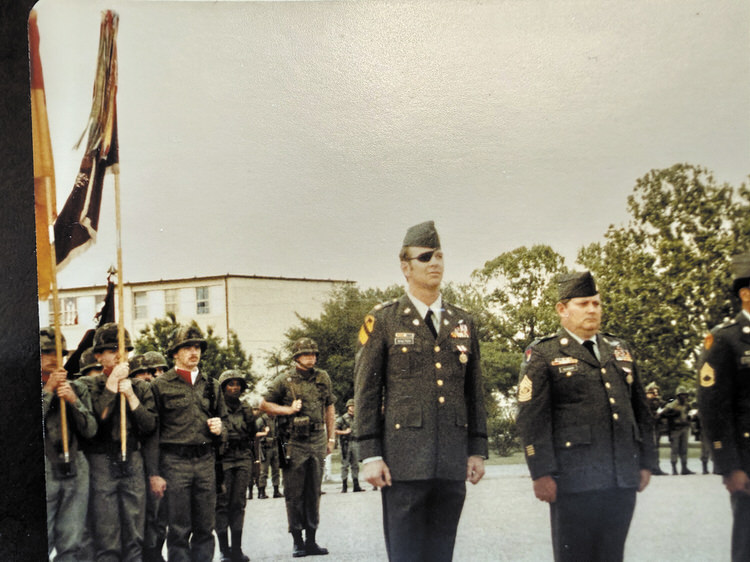
Roy at Fort Hood.
Mike Pate
Retired Army Major Roy Walton
The Day It All Changed:
Eight months into Roy’s tour of Vietnam, a Medevac pilot radioed for help. He was pinned by heavy enemy fire and unable to evacuate wounded soldiers. Roy and two fellow Cobra pilots volunteered to act as decoys, drawing fire away so the Medevac could make the pickup.
“The plan worked,” Roy said. “The Medevac pilot made his pickup. But it worked too well. I got shot right away.”
Traveling upward through the bottom of his Cobra, the bullet tore through ammo trays and circuit breakers before striking the wallet in Roy’s pant leg pocket, slowing just enough on its ascent to lodge between his eyeball and eyelid. It missed his brain by fractions of an inch.
“God was with me that day,” he said. “If the bullet had gone any farther, I wouldn’t be here today.”
Blinded and unable to fly, Roy turned to his copilot and said the only thing he could: “I’m hit. You’ve got this.” But his copilot didn’t have it—this was his very first mission in Vietnam, and he was completely unfamiliar with the terrain and landmarks. In pain and unable to see clearly, Roy had to talk him through the flight back to base.
Later, Roy learned just how traumatic the experience had been for the young aviator. The stress was so overwhelming that the Army reassigned him to another unit.
Roy was evacuated to a medical ship in the South China Sea and then transferred to Japan for surgery on his eye. He continued his recovery at Fort Lewis in Washington State, where he received confirmation that he could no longer be assigned to combat. Expecting a medical discharge, Roy assumed his Army career was over.
From Air to Ground:
The Army, however, wasn’t finished with Roy—and Roy, true to form, wasn’t finished serving. Once released from the hospital, he remained at Fort Lewis for several years, putting his trademark “can do” spirit to work in new ways. He first served as a staff officer under the Garrison Commander, then commanded the special processing department, where he handled cases involving soldiers who had gone awol. It was demanding, often delicate work, and Roy approached it with the same steadiness he had shown in the cockpit.
His performance earned him selection for the armor officer advanced course at Fort Knox, Ky., where he traded rotor blades for treads and learned the intricacies of tank warfare. Upon graduation, now 28, he was assigned to the 67th armor battalion, second armored division at Fort Hood, Texas—quite literally a shift from air to ground. As a tank company commander, he spent a year putting a new version of the M60 tank through rigorous field and gunnery tests, ensuring it was ready for the soldiers who would rely on it.
“Bloom where you are planted” could easily be Roy’s personal motto. After his tank command, he became assistant inspector general for the second armored division, conducting unit inspections and addressing soldier concerns with fairness and clarity. Concurrently, he completed the demanding Command and General Staff College, preparing him for higher level leadership.
His final—and arguably favorite—assignment on active duty was serving for the second armored division adjutant general. As an administrative officer, he oversaw personnel readiness, records, and services for his division. But what made the role truly special had nothing to do with paperwork or policy. It was there that he met Christine, the officer who would become his wife. (Part 3 of 3 in June).